Episode 184
Ajme, prijatelji! I think our sink is broken! Does anyone know any handyman vocabulary in Croatian? Thankfully, we’ll learn a few words and phrases in this episode in case we’re need of some professional help.
Lesson
Tools - alati
Professions - profesije
Plumber - Vodoinstalater
Electrician - Električar
Handy man - majstor
We need to call a professional. - Trebamo zvati profesionalca.
I can fix that. - Mogu to popraviti.
I’ll look it up on Youtube. - Pogledati ču na Youtube.
That’s how you solve it. - Tako se to riješava.
Super Slatko Report
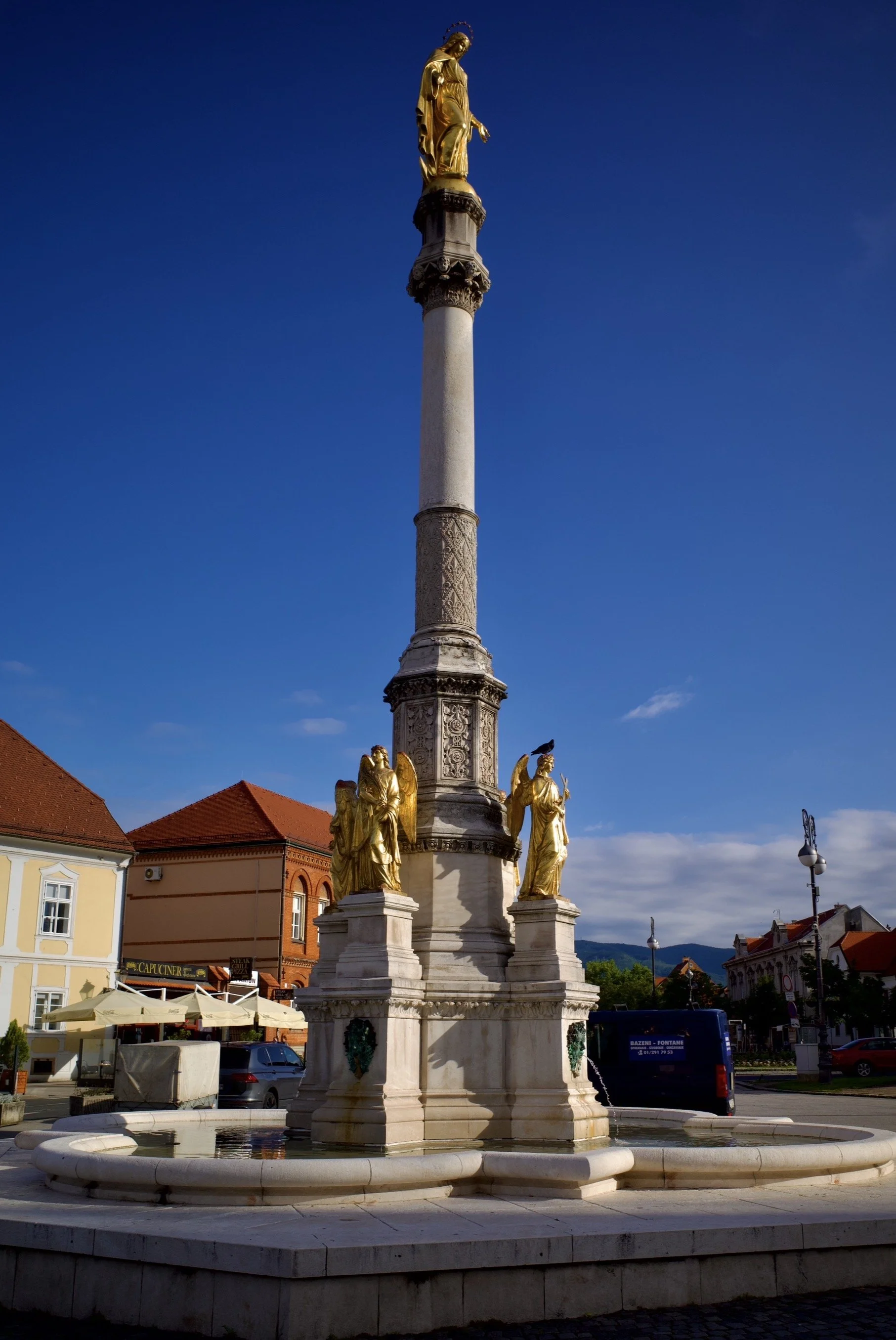
In this edition of the Super Slatko Report, DJ Moe will tell us about he Holy Mary Monument in Zagreb. It’s a tall and beautiful centerpiece in Croatia’s biggest city. Join us to learn more!
Standing in Zagreb’s historic Kaptol Square is the Monument of the Assumption of the Blessed Virgin Mary, better known as the Holy Mary Monument or simply the Marian Column. Rising to roughly 30 meters (98 feet) it combines a stone Neo-Gothic fountain and column with gilded metal figures of Mary and four angels. The sculptures were first installed above Hermann Bollé’s existing fountain on June 18, 1873, while the monument’s present Neo-Gothic architectural form add on (the statues and finishings) were developed between 1879 and 1881. When looking at the Monument you’d see Mary standing at the top with bowed head and open arms, while four angels occupying the lower corners, each facing outward so the virtues they represent extend symbolically in every direction. Digging into this, I couldn’t find references to their exact compass headings, so we aren’t entirely sure if their direction carry separate meanings. The monument stands immediately before Zagreb Cathedral, less than 0.1 kilometer, (0.06 mile), from its entrance; approximately 0.2 kilometer, (0.12 mile), from Dolac Market; and roughly 0.35 kilometer, (0.22 mile), from Ban Jelačić Square. In other words, Mary enjoys excellent neighbors and is within comfortable walking distance of prayer, produce, and public transportation.
The monument is really the work of three Central European heavyweights. Its gilded figures were created by Anton Dominik Fernkorn, a German-born Austrian sculptor born in Erfurt in 1813 who became one of Vienna’s great makers of monumental bronze sculpture. He also sculpted the statue of Ban Josip Jelačić you will find him in his namesake square, should you feel so inclined. The redesigned column and fountain were conceived by German-born Viennese architect Friedrich von Schmidt, born in Frickenhofen in 1825. Schmidt’s younger collaborator Hermann Bollé, born in Cologne in 1845, carried the Zagreb project into reality. Bollé would leave fingerprints all over the city, the Zagreb Cathedral and the arcades at Mirogoj Cemetery. The monument therefore took a trio to complete: Fernkorn provided the figures, Schmidt arranged the design and transformation, and Bollé made the original fountain and put it all together.
The original idea was to place a highly visible expression of Marian devotion directly before the cathedral dedicated to the Assumption of the Blessed Virgin Mary. Mary had long been regarded not merely as a religious figure but as a heavenly protector of Croatia, so raising her above Kaptol, a historic neighborhood in Zagreb, connected faith, local identity, and the authority of the cathedral in one artistic expression. The gilded figures were installed in 1873, but after Friedrich von Schmidt visited Zagreb in 1877, the setting was reconsidered and transformed into the taller, more unified composition completed under Bollé. This was not a case of an unpopular Mary being evicted and replaced by a newer model. The figures remained the heart of the monument, while their architectural surroundings were altered to harmonize with ambitious plans for the cathedral and Kaptol. The change took Mary from an ornamental fountain arrangement and gave her a stronger vertical sweep, visually lifting her toward the cathedral towers.
For the people seeing it in the late nineteenth century, this was not simply decorative street furniture with excellent gold coverage. Zagreb was growing from a compact town of blue collar hard working people into a modern Central European capital. Kaptol itself was the city’s ecclesiastical center, while nearby Dolac and the streets descending toward the main square carried the everyday traffic of trade and work. Most of the people passing by were not art historians debating architectural meanings and symbolism; they were ordinary people buying food, delivering goods, attending Mass, drawing water; just regular everyday folks. To them, Mary could represent protection, continuity, and a reassuring spiritual presence above a rapidly changing city. The fountain also gave the monument a practical connection to daily life. Faith may have been looking upward, but Zagreb still needed water at street level.
Today, when you see the monument, look past the initial flash of gold and examine it from the bottom upward. Water anchors the composition to daily earthly life, the four angels represent Faith, Hope, Innocence/Purity, and Humility, and Mary rises above them as a figure of protection and the Assumption. When you see it, you’ll notice how the angels look outward rather than gathering like a single audience beneath her, huddled together; instead they carry the monument’s virtues into the surrounding city and to the people. After taking that in, step back and see how the pointed column echoes the upward movement of the cathedral behind it, as if the monument and Cathedral are working together. Through the years, the monument has been cleaned, repaired, and regilded, while the cathedral and Kaptol around it have endured earthquakes, reconstruction, changing governments, and changing skylines. Mary and her angels are a constant presence for the locals and visitors alike, providing that sense of protection, regardless of all the changes to their the city has gone through over the years.
And that’s it for the Super Slatko report.