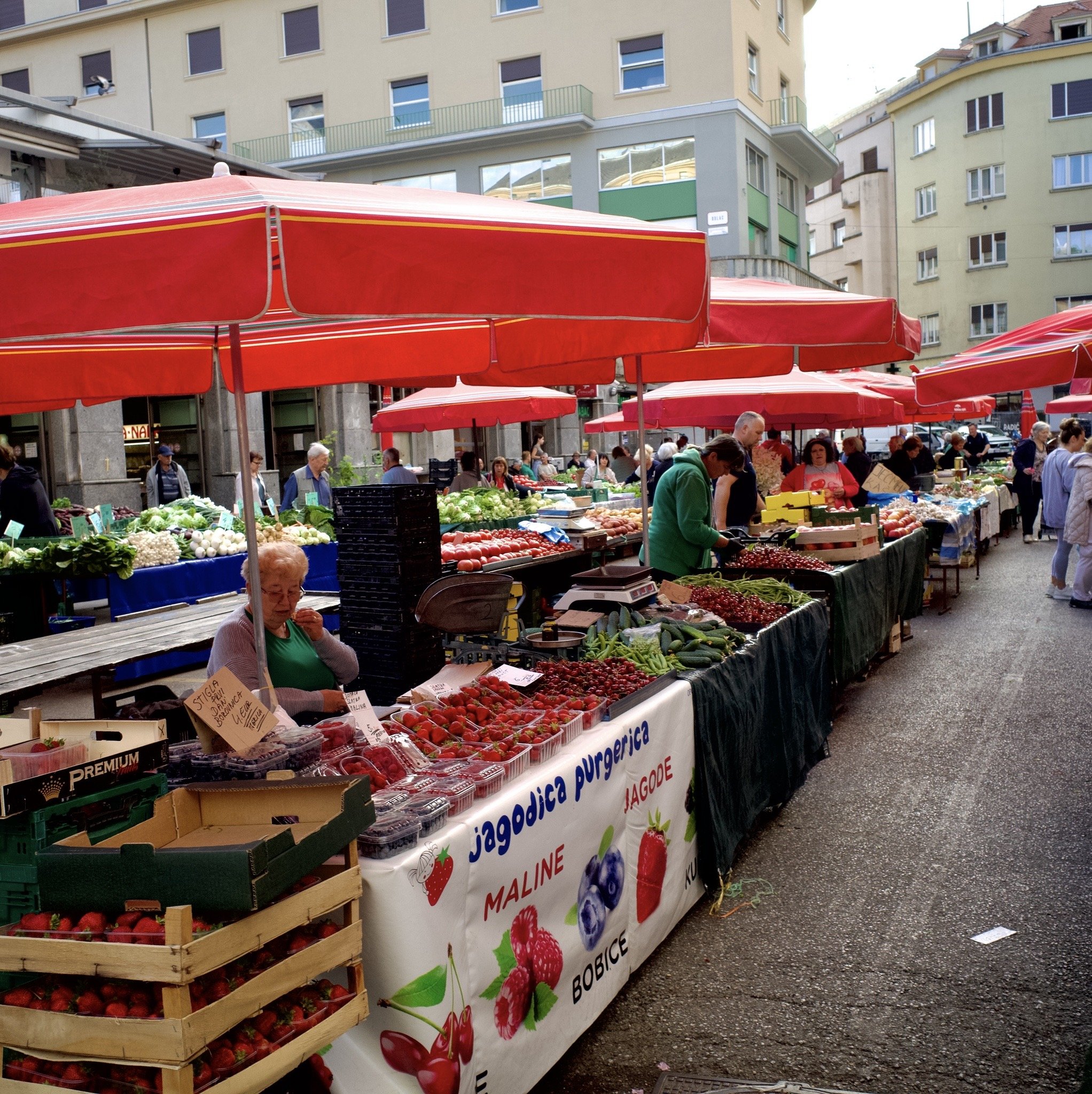
Episode 182
Dobar tek, prijatelji!
We hope you’re hungry for a fresh summer salad in the Croatian style!
In this lesson, we’ll be learning a recipe for a mixed salad.
You’ll learn new vocabulary and a new recipe!
Lesson
Mixed Salad - miješana salata
Today we’re preparing mixed salad. - Danas pripremamo miješanu salatu.
Vrijeme pripreme - 10 minuti
Sastojci: rajčice, krastavci, crveni luk, vinski ocat, maslinovo ulje, sol i papar.
To cut or chop - narezati
Chop tomatoes, cucumbers and red onions. - Narežite rajčice, krastavce i crveni luk.
Season with salt and pepper. - Začinite solju i paprom.
Add vinegar and olive oil. - Dodajte vinski ocat i maslinovo ulje.
Serve cold. - Poslužite hladno.
Super Slatko Report
In this edition of the Super Slatko Report, DJ Moe will tell us about a culinary powerhouse that’s mandatory in all Croatian kitchens: Vegeta! What is it and when do you use it? Join us and find out.
If you’ve ever peeked into a Croatian kitchen, you’ve probably noticed that seasoning isn’t just an afterthought. Long before Vegeta ever found its way onto pantry shelves, Croatian cooks relied on simple, fresh ingredients to build flavor: sea salt harvested from the Adriatic coast, cracked black pepper, garlic, onions, parsley, bay leaves, paprika, and homegrown vegetables simmered into soups, stews, and sauces. Every household had its own little kuhinske tajne (culinary secrets) and recipes were often passed down with a healthy serving of “just enough of this” and “a pinch of that.” Then, in 1959, everything changed. A Croatian food company called Podravka introduced a little blue packet called Vegeta, created by food technologist Zlata Bartl, a Bosnian-Croatian Scientist. Zlata and her research team in Koprivnica, northern Croatia are the masterminds behind the Vegeta miracle. Bartl’s goal was simple, capture the comforting taste of homemade vegetable broth in one convenient seasoning.
The company behind Vegeta, Podravka, is headquartered in the city of Koprivnica, about 97 kilometers northeast of Zagreb (60 miles). Founded in 1934 as a small fruit-processing business, Podravka gradually grew into one of Croatia’s largest and most recognizable food companies. While Vegeta is undoubtedly its international one-name superstar, the company also produces jams, soups, pasta, sauces, canned vegetables, baby foods, frozen meals, and beverages. Across the former Yugoslavia and much of Central and Eastern Europe, Podravka is as familiar as household names like Campbell’s or Heinz are elsewhere.
So, what exactly is Vegeta made of? The original Vegeta recipe blends salt with dehydrated vegetables, including carrots, parsnips, onions, celery root, parsley leaves, and a handful of carefully balanced spices. It also contains flavor enhancers, which help intensify its savory, umami character. Much of the vegetables come from agricultural regions surrounding Podravka’s production facilities in Croatia, along with additional European suppliers when needed to meet worldwide demand. While the precise spice blend remains proprietary, the overall goal has never changed: create a seasoning that tastes like someone spent hours simmering vegetables on the stove, even if dinner needs to be ready in twenty minutes.
Taste-wise, Vegeta delivers a wonderfully balanced combination of salty, savory, slightly sweet vegetable flavors with subtle herbal notes. Sprinkle a little directly on your tongue and you’ll immediately recognize concentrated vegetable soup, followed by hints of onion, celery, parsley, and carrot. It shines brightest in soups, stews, roasted potatoes, rice, risotto, grilled vegetables, meats, scrambled eggs, and even popcorn if you’re feeling adventurous. In Croatia and neighboring countries, dishes like sarma, grah (bean stew), beef soup, chicken soup, stuffed peppers, and countless meat and vegetable dishes often receive their signature flavor from a spoonful of Vegeta. Comparable products include Knorr, Aromat, Maggi Seasoning, Herbamare, or homemade vegetable-salt blends, but longtime fans will quickly tell you that none quite recreate Vegeta’s unmistakable balance.
Today, finding Vegeta is easier than ever. It’s sold throughout Croatia, across Europe, North America, Australia, and many parts of Asia and South America. You’ll commonly spot it in Croatian, Serbian, Bosnian, Polish, Russian, or other Eastern European grocery stores, and it’s increasingly appearing in mainstream supermarkets alongside international foods. Of course, online retailers have made it even easier to stock your pantry. It typically comes in small 75-gram packets, medium boxes around 250 grams, larger 500-gram containers, and hefty one-kilogram tubs for serious cooks. Prices will vary by country, but guesstimate to pay roughly $2 to $4 USD for a small package, $5 to $8 for a 250-gram box, $9 to $15 for a 500-gram container, and around $15 to $25 for the one-kilogram size. For something measured by the teaspoon, so long as you’re not heavy handed, one could really make it last a while.
For many Croatians, Vegeta isn’t simply another spice, it’s comfort, nostalgia, and family dinners wrapped up in a blue package. Countless people grew up watching parents and grandparents add “just one spoonful” to nearly everything. Its popularity remains incredibly strong because it’s reliable, consistent, and instantly recognizable. That said, not everyone is equally enthusiastic. Some cooks prefer building flavor from fresh vegetables alone, while others avoid Vegeta because of its sodium content or its use of flavor enhancers. Is it something every kitchen should have? If you enjoy soups, roasted vegetables, rice dishes, or hearty comfort food, it’s certainly worth trying at least once. If you can’t find it, a mixture of vegetable bouillon powder, celery salt, onion powder, garlic powder, dried parsley, carrot powder, and a pinch of paprika can produce a surprisingly respectable stand-in.
So, before Vegeta, Croatian cooks relied on fresh herbs, vegetables, and generations of instinct to build unforgettable meals. Then along came Zlata and the Podravka company in 1959, packaging those comforting flavors into one of Croatia’s most successful culinary exports. From soups and stews to roasted potatoes, stuffed peppers, sarma, and bean dishes, Vegeta has become a quiet hero in kitchens around the world, proving that sometimes the smallest ingredient makes the biggest difference. Whether you become a lifelong fan or simply sprinkle a little into your next pot of soup out of curiosity, that’s entirely up to you. But fair warning: once you’ve experienced the flavor, you may find yourself reaching for that familiar blue container more often than you expected.
And that’s it for the super Slatko report.