Episode 177
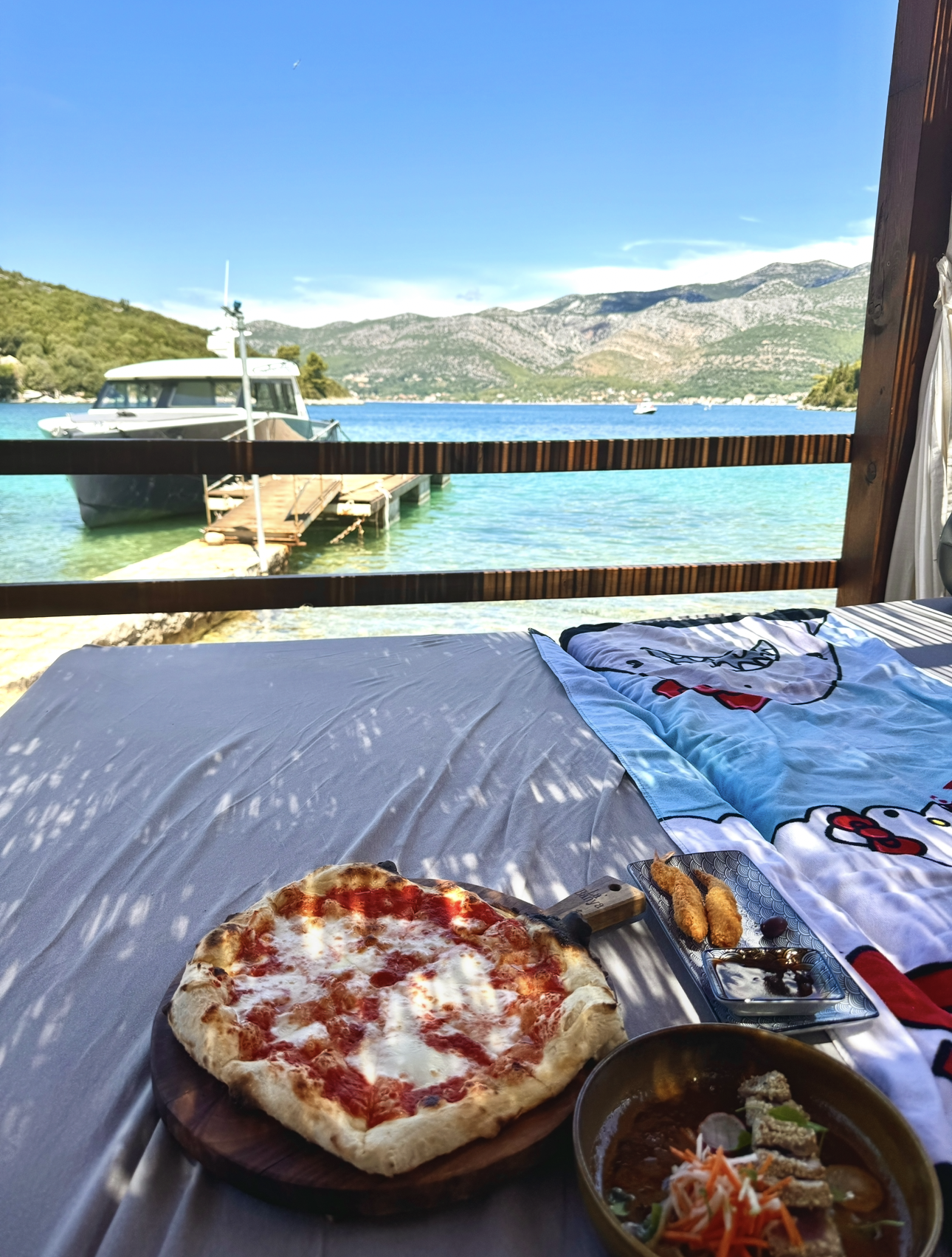
Big thanks to friend of the pod, Quy for sharing over this amazing photo.
Dobar tek, prijatelji!
Danas smo gladni.
We’re hungry today.
Shall we go out to a Croatian restaurant?
In this episode we’ll learn the vocabulary of a food menu.
My fork and knife are ready.
Lesson
food menu - jelovnik
meal/dish - jelo
appetizers - predjela
soup - juha
salad - salate
main dish - glavno jelo
sides - prilozi
dessert - desert
Super Slatko Report
In this edition of the Super Slatko Report, DJ Moe will tell us about some of the history behind the Seven Castles of Dalmatia. These magical places vibe heavy with Game of Thrones and Helm’s Deep. Join us!
Along the shimmering stretch of the Dalmatian coastline between modern-day Split and Trogir sits one of the Adriatic’s most underrated defensive systems: the seven Kaštela castles. During the 15th and 16th centuries, the expanding Ottoman–Habsburg Wars pushed deeper into the Balkans, raiding villages, disrupting trade, and threatening the wealthy coastal settlements of Dalmatia. Venetian nobles, Croatian aristocrats, church officials, and local families were all involved. Why? because the Ottomans were not just after land; they were after l strategic control over trade routes, taxation, ports, and influence across the Adriatic frontier. Their response? Build fortified settlements directly along roughly 20 kilometers of coastline (12.4 miles); to act as little stone lifeboats where villagers could flee during attacks. Over time, those fortified settlements evolved into the seven Kaštela we know today: a chain of castles that essentially functioned like medieval neighborhood watch towers… except with cannons, drawbridges, and significantly higher stakes.
The first of these was Kaštel Gomilica, about 12 kilometers (7.5 miles) northwest of Split. Built in 1529 by Benedictine nuns fleeing Ottoman pressure inland. The fortress was constructed on a small islet connected to the mainland by a bridge. That island design was not accidental; it made surprise attacks far more difficult and gave defenders visibility in every direction. The castle was built from local Dalmatian limestone, featuring thick defensive walls and corner towers designed more for practicality than elegance. One of its most recognizable features today is the fortified gate and bridge approach, which practically screams “please reconsider trying to invade us.” Kaštel Gomilica did experience periods of military tension during Ottoman coastal raids, though its strongest legacy today may actually come from pop culture. As I teased earlier, for those eagle-eyed Game of Thrones viewers out there, you might recognize this castle as the Free City of Bravos, where Aria Stark sold oysters and clams to Bravosi sailors and tradesmen. Today, the castle area is open to visitors, and the old fortified village surrounding it remains beautifully preserved.
Next comes Kaštel Sućurac in Kaštel Sućurac, the easternmost of the seven settlements and only about 5 kilometers (3 miles) from Split. It was originally established in 1392 by the Archbishop of Split, making it one of the earliest fortified structures in the chain. Unlike some later castles built directly offshore, Sućurac began as a fortified manor near the coast, protected by towers and defensive walls. Constructed primarily from local stone, the complex featured narrow defensive windows, elevated living quarters, and fortified entrances designed to slow advancing attackers. Unfortunately, Kaštel Sućurac saw some of the harshest fighting of the group. In 1500, Ottoman forces attacked and heavily damaged the settlement, leading to later reinforcements and rebuilding efforts. The castle’s story reflects the reality of life on the Ottoman frontier: survival often meant rebuilding. Today, visitors can still see portions of the old fortifications woven into the modern town itself.
Kaštel Kambelovac, roughly 10 kilometers (6 miles) from Split, actually developed from several smaller noble fortifications built during the 15th century by the Cambi family. The Cambis were a noble family from Split who clearly believed that “multiple castles are better than one.” Their main fortress, completed around 1478, was built on reefs just offshore and connected by a bridge. Architecturally, it combined Gothic and Renaissance influences with pure military practicality: defensive towers, high walls, and controlled access points. Its rectangular design allowed defenders to maximize visibility over the bay while protecting local villagers during raids. Kaštel Kambelovac’s offshore positioning was especially clever because attackers had to expose themselves crossing open ground or water. Today, the town remains lively, and parts of the original castle structures still stand integrated into the waterfront town.
Then we arrive at Kaštel Lukšić about 13 kilometers (8 miles) from Split. Built in 1487 by the Vitturi family of Trogir, this may be the most visually romantic of all the Kaštela castles. The Vitturis constructed it on a small artificial island connected by a drawbridge, creating a structure that blended luxury with defense. The castle used finely cut limestone and incorporated Renaissance architectural details uncommon in purely military forts, including elegant windows and residential halls. Yet beneath the beauty sat serious defensive infrastructure: fortified walls, towers, and restricted entrances. Kaštel Lukšić is also tied to one of Croatia’s most famous tragic love stories, that of Miljenko and Dobrila; often described as the Croatian Romeo and Juliet. Their story unfolded among these noble families during the 17th century, adding another layer of drama to a place already surrounded by war and politics. Today, the restored Vitturi Castle functions as a cultural center and museum open to visitors.
Kaštel Stari, lies about 18 kilometers (11 miles) west of Split and grew around a fortress known as Kaštilac, built in 1476 by the noble Cippico family from Trogir. The Cippicos constructed the castle near the sea with fortified walls, towers, and living quarters that could shelter local peasants during attacks. Unlike some of the more island-based castles, Kaštel Stari’s defensive design focused heavily on layered walls and strong gate systems. The town eventually expanded around the original fortress, creating the “Old Castle” identity the town still carries today. Ottoman raids threatened the area repeatedly through the 16th century, though the settlement endured and continued developing. Visitors today can wander through old stone streets where medieval defensive planning and coastal Dalmatian life still feel intertwined.
Kaštel Novi, located roughly 17 kilometers (10.5 miles) from Split, was established in 1512 by Pavao Ćipiko, another member of the influential Cippico family. As its name suggests, “New Castle.” This settlement represented the continuing expansion of the defensive chain. The fortress featured sturdy rectangular defensive walls, corner towers, and a carefully controlled shoreline approach. Local limestone dominated construction once again, because Dalmatia essentially has two permanent architectural settings: “beautiful coastal stone” and “more beautiful coastal stone.” Kaštel Novi served both military and civilian purposes, providing refuge for surrounding villagers while also supporting trade and fishing activity. Over time, the settlement became one of the more populated Kaštela communities, and today its old core remains active with cafés, promenades, and restored historic buildings.
Finally, there is Kaštel Štafilić the westernmost of the seven settlements and only about 8 kilometers (5 miles) east of Trogir. Built in 1508 by the nobleman Stjepan Štafilić from Trogir, this castle was constructed directly along the shoreline with fortified walls and a prominent defensive tower. The structure included residential quarters, storage areas, and defensive lookout points, all designed to guard against sudden coastal attacks. One especially famous feature nearby is the ancient olive tree known as the Mastrinka, believed to be over 1,500 years old; one of the oldest olive trees in Croatia. While Kaštel Štafilić may not have seen the same large-scale destruction as Sućurac, it remained an important part of the defensive network monitoring movement along the bay. Today, the old castle district remains accessible to visitors and sits close to Split Airport, meaning travelers unknowingly pass near centuries of frontier history every day.
Looking back across all seven Kaštela, several themes jump out at you: proximity to the sea, controlled access points, thick limestone walls, defensive towers, and the blending of civilian life with military necessity. These were not isolated military forts staffed only by soldiers; they were functioning communities designed to protect families, trade, churches, crops, and daily life itself. The repeated use of offshore islands, bridges, and layered gates shows how seriously the Ottoman threat was taken. And in many ways, yes; the castles absolutely succeeded. They slowed raids, protected populations, preserved coastal settlements, and helped maintain Venetian and Croatian control along this vital Adriatic area. More importantly, they allowed these communities to survive long enough to evolve into the towns still standing today. In other words, the greatest victory of the Kaštela castles may not have been military glory at all. It was continuity. The fact that centuries later, people still live, walk, fish, laugh, drink coffee, and argue about parking along this coastline means those stone defenses ultimately did exactly what they were built to do.
And that’s it for the Super Slatko report.